Self-guided itinerary · free
Pamukkale and Denizli in 2 days: travertines and ancient cities
Pamukkale's white limestone terraces and the ancient city of Hierapolis share one site and one ticket, so day one is given entirely to it. Climb the travertines barefoot early in the morning on the footpath from the village, swim if you like in the thermal Antique Pool among fallen columns, see the museum inside the site and spend the afternoon in the ancient city from the theatre to the necropolis. Day two moves to the Denizli side: the quieter, broad-streeted Laodicea in the morning, the cable car up to cool Bağbaşı plateau at midday, and the city museums and wood-oven Denizli kebab in the evening. The plan follows winter visiting hours; remember that the footpath closes before all the gates. Opening hours and fees link to the official source with the date we last checked them.
Prepared by: Kolay Seyahat content teamLast updated 22/10/2026Every fact links to an official source

This is not a package tour. This itinerary is free information. Flights, hotels and experiences are each sold separately, under their own seller’s terms, with separate payment and a separate contract. Prices are never linked to one another.
Day by day
Progress is saved on this device only. Your location is never sent.
Day 1 · The travertines and Hierapolis
Walk up the travertines from the village at opening time, swim in the Antique Pool if you like, see the site museum and spend the afternoon in Hierapolis from the theatre to the northern necropolis; come down before the footpath closes.
Day 1 · 1 · 08:00–09:30
The travertines: walking up the footpath
Closed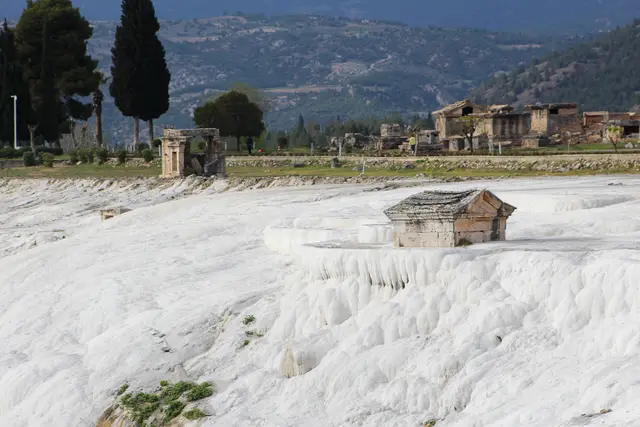
The finest way to see Pamukkale is to walk up the footpath that starts in the village. You take your shoes off at the gate; the white limestone with warm water running over it is soft underfoot but gritty in places. The slope rises gently, the pools turn a little bluer with every step and the village shrinks below. In the first hour of the morning the terraces are not yet crowded, and this is when the light paints them best. Because the terraces are fragile, you may walk and paddle only in the sections left open; stay on the marked path.
Getting there
- Walk
Opening hours
In the winter period (14 September 2026 – 1 May 2027) the Pamukkale Hierapolis footpath is open 08:00–17:00.
Source: Denizli İl Kültür ve Turizm Müdürlüğü · last checked 2026-10-22
Closed
Open every day.
Source: muze.gov.tr · last checked 2026-10-22
Entrance fee
The ministry list shows € 30 for foreign visitors; Turkish citizens can enter with the Müzekart. One ticket covers the whole site. The list is undated, so check the current fee on muze.gov.tr e-ticketing or at the gate.
Source: DÖSİMM · last checked 2026-10-22
Good to know
Visitors may use only the main paths and must remove their footwear to stand on the calcium deposits.
Source: Kültür ve Turizm Bakanlığı · last checked 2026-10-22
Tips
Bring a light bag for your shoes and a small towel for your feet. On winter mornings the ground is cold and wet patches can be slippery, so take it slowly. The footpath closes earlier than the gates, which is why the plan walks it at the start of the day.
Day 1 · 2 · 09:30–10:30
The Antique Pool (optional)
A few minutes' walk from the top of the travertines brings you to the thermal pool where toppled columns and marble fragments lie on the bottom. According to GoTürkiye its water stays at 36 degrees all year, and because Cleopatra is said to have bathed here it is also called Cleopatra's Pool. Swimming in warm water among the remains of an ancient city makes it clear that Pamukkale is not just a view but part of a healing tradition thousands of years old. It is charged separately; the rest of the plan works fine without it.
Getting there
- Walk
Opening hours
In the winter period (14 September 2026 – 1 May 2027) 08:00–17:30.
Source: Denizli İl Kültür ve Turizm Müdürlüğü · last checked 2026-10-22
Entrance fee
Foreign adults and children over 12: 600 TL; foreign children aged 7–12: 300 TL; Turkish adults with a Müzekart: 235 TL; Turkish visitors aged 7–18: 125 TL; under 7 free. Disabled visitors and one companion enter free.
Source: Denizli İl Kültür ve Turizm Müdürlüğü · last checked 2026-10-22
Good to know
The Antique Pool is open to visitors.
Source: muze.gov.tr · last checked 2026-10-22
Tips
Bring your swimwear; there are toilets, showers and lockers on site. Check at the entrance that the pool is open.
Day 1 · 3 · 10:30–11:30
Hierapolis Archaeology Museum
ClosedThis museum inside the site gathers finds from Hierapolis and its surroundings. Giving it an hour before you walk the theatre, temples and tombs outside helps you understand what you are looking at among the stones. The finds tell the life of the busy city that once stood on these limestone terraces more vividly than the ruins alone.
Getting there
- Walk
Opening hours
In winter the provincial directorate gives 08:00–17:00; the ministry page shows a 17:30 close. Go in before 17:00 and check at the entrance.
Source: Denizli İl Kültür ve Turizm Müdürlüğü · last checked 2026-10-22
Closed
Open every day.
Source: muze.gov.tr · last checked 2026-10-22
Entrance fee
Free; the Müzekart is valid for Turkish citizens.
Source: DÖSİMM · last checked 2026-10-22
Tips
No separate ticket is needed; your site ticket already gets you into the area. It is also a good way to spend time indoors before the midday heat.
Day 1 · 4 · 11:30–13:00
The theatre, the Sanctuary of Apollo and the Plutonion
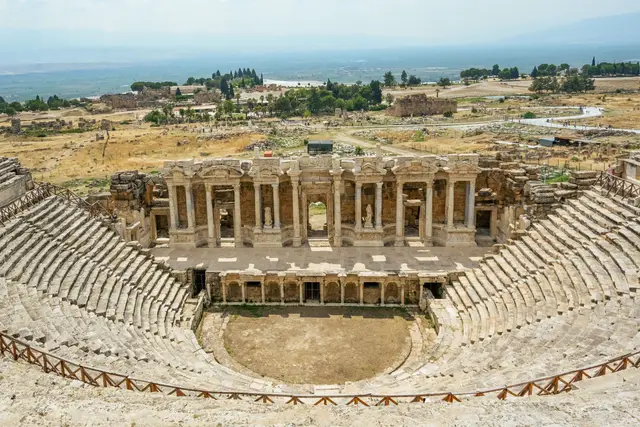
Walk uphill towards the heart of Hierapolis. The theatre set into the slope frames both its stage and the plain below from its seats. A little lower lie the sanctuary of Apollo, the city's chief god, and just south of it the Plutonion, which the ancient world saw as a gate to the underworld. Together they best explain why Hierapolis was a city of pilgrimage and healing, where hot springs, toxic vapours and sacred places stood side by side.
Getting there
- Walk
Good to know
The Plutonion lies south of the Sanctuary of Apollo.
Source: Kültür Portalı · last checked 2026-10-22
Tips
The path to the theatre is steep with little shade; bring a hat and water. Break for lunch in or near the site to recharge for the afternoon.
Day 1 · 5 · 14:00–16:00
Frontinus Street, the agora and the northern necropolis
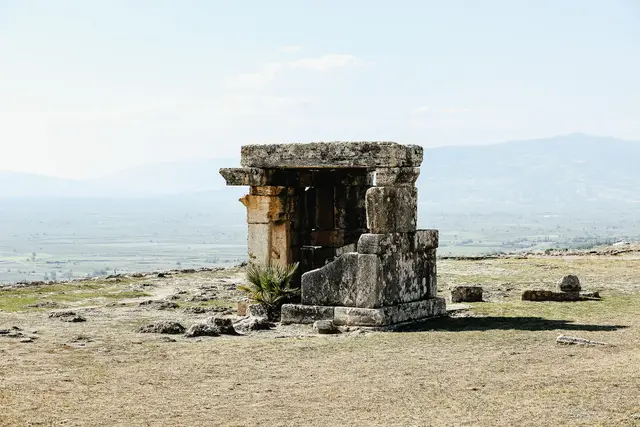
In the afternoon head north. Walking colonnaded Frontinus Street you measure with your own feet the length of the main avenue once lined with shops and crowds. At its end you pass through the city gate to the necropolis, the cemetery outside the walls, where sarcophagi and monumental tombs also tell of those who came for a cure and never left. This is the widest and quietest part of the site; wander at your own pace.
Getting there
- Walk
Opening hours
The South and North Gates close at 18:00 and the footpath entrance at 17:00. Check the last entry time at the gate.
Source: muze.gov.tr · last checked 2026-10-22
Tips
The North Gate is close to this area, and you can leave from here. If you want to walk down the footpath, plan to be back at the travertines before it closes.
Day 1 · 6 · 16:00–17:00
Down through the travertines
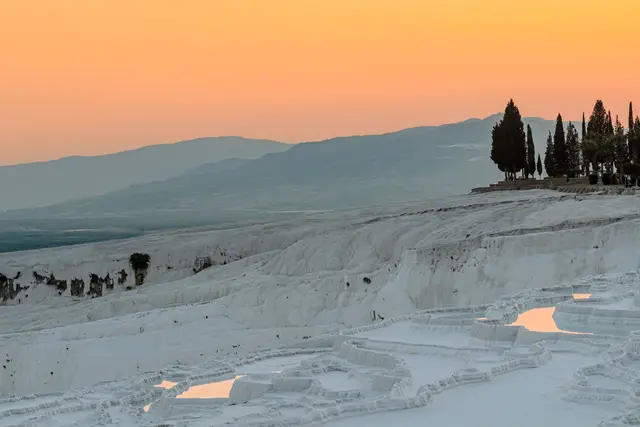
Finish where you began. In the late afternoon light the white terraces look nothing like the morning: as the sun drops the pools take on the colour of the sky and the village below sits among long shadows. Take your shoes off again and walk slowly down the footpath. If you are staying in the village you can spend the evening there; if you are in Denizli centre, ride the city bus back.
Getting there
- Walk
Good to know
Because the travertines are fragile, you may walk on and enter the water only in certain sections.
Source: Kültür Portalı · last checked 2026-10-22
Tips
Winter days are short; if you want the sunset, allow for the footpath closing time and the walk down, and do not leave it to the last minute.


Day 2 · Laodicea, the cable car and central Denizli
Explore the quiet, spacious ancient city of Laodicea in the morning, ride the cable car to Bağbaşı plateau for lunch, see the city museums in the late afternoon and end the day with Denizli kebab around Çınar.
Day 2 · 1 · 08:30–11:00
The ancient city of Laodicea
Closed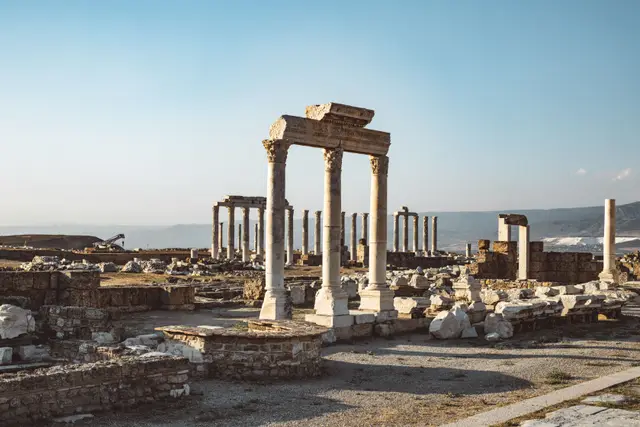
After the crowds of Hierapolis, Laodicea is a breath of air. GoTürkiye describes it as home to one of the seven churches named in the Bible and one of history's great trading centres. With its broad colonnaded streets and large buildings it is one of the best places to feel the scale of an ancient city; visitors are few and the walks are long. With the audio guide it is easier to fill the gaps between the ruins with their stories.
Opening hours
In winter the provincial directorate gives 08:00–17:00; the ministry page shows a 17:30 close. Go in before 17:00 and check at the entrance.
Source: Denizli İl Kültür ve Turizm Müdürlüğü · last checked 2026-10-22
Closed
Open every day.
Source: muze.gov.tr · last checked 2026-10-22
Entrance fee
The ministry list shows € 12 for foreign visitors; Turkish citizens can enter with the Müzekart. The list is undated, so check the current fee on muze.gov.tr or at the gate.
Source: DÖSİMM · last checked 2026-10-22
Good to know
Address: Goncalı, Merkez/Pamukkale. An audio guide is available.
Source: muze.gov.tr · last checked 2026-10-22
Tips
The city covers a large area with little shade; bring comfortable shoes, a hat and water. Driving or a taxi from Denizli is easiest; no city bus line could be confirmed from an official source.
Day 2 · 2 · 11:30–14:30
Denizli cable car and Bağbaşı plateau
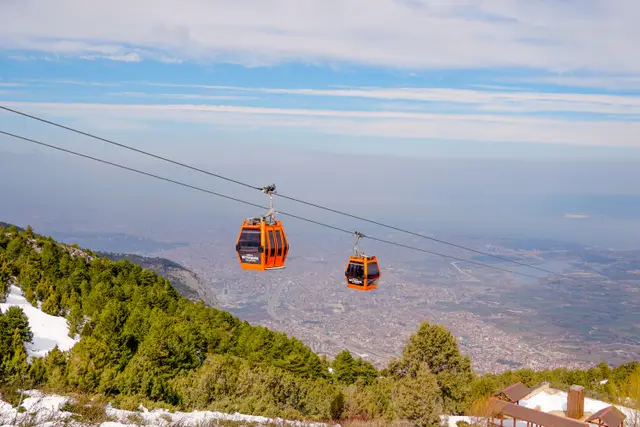
A short cabin ride lifts you from the city heat to a cool plateau. The cable car leaves from a lower station in the Bağbaşı city forest, and as it climbs the Denizli plain opens beneath your feet. Up top, the Bağbaşı plateau, known for its olive groves, has walking paths, picnic areas and places to eat; lunch here, looking down on the city, is the most relaxed moment of the day. On a clear day, look out towards the travertines.
Opening hours
Check the official site for current information
Source: Denizli Büyükşehir Belediyesi · last checked 2026-10-22
Good to know
The metropolitan municipality's cable car line is 1,500 metres long with 24 eight-person cabins; Bağbaşı Olive Plateau stands at 1,400 metres. There is a café at the top station and restaurants, cafés and picnic areas on the plateau.
Source: Denizli İl Kültür ve Turizm Müdürlüğü · last checked 2026-10-22
Tips
Times and fares are not published on the official page; check with the metropolitan municipality (ALO 153) before you go. If the cable car is not running, spend the afternoon at the city museums instead.
Day 2 · 3 · 15:00–16:00
Denizli City Museum
ClosedBack in town, take a short break with more recent history. According to GoTürkiye the museum fills nine exhibition rooms in restored early-Republican buildings. After the ancient cities it tells Denizli's own story, from weaving to trade, and how today's city took shape. It is a good way to connect the deep past of the last two days with the streets you are walking now.
Opening hours
In the winter period, 08:30–17:30.
Source: Denizli İl Kültür ve Turizm Müdürlüğü · last checked 2026-10-22
Closed
Closed on Mondays.
Source: Denizli İl Kültür ve Turizm Müdürlüğü · last checked 2026-10-22
Entrance fee
Check the official site for current information
Source: DÖSİMM · last checked 2026-10-22
Tips
It is closed on Mondays; if your day two is a Monday, spend the afternoon walking around Çınar instead.
Day 2 · 4 · 16:00–17:00
Atatürk and Ethnography Museum
ClosedAs its name says, the day's last museum is devoted to the region's ethnography and to Atatürk. It sets the recent past of the people of this land beside the grand history of the travertines and the ancient cities. A short visit is enough; then walk to the Çınar area for dinner.
Opening hours
In the winter period, 08:30–17:30.
Source: Denizli İl Kültür ve Turizm Müdürlüğü · last checked 2026-10-22
Closed
Closed on Mondays.
Source: Denizli İl Kültür ve Turizm Müdürlüğü · last checked 2026-10-22
Tips
This museum is also closed on Mondays. To fit it in with the City Museum, finish both before closing time.
Day 2 · 5 · 17:00–19:00
Around Çınar and Denizli kebab
The last stop of the trip is at the table. Denizli kebab is lamb slow-roasted in a wood-fired oven, cut into pieces and served with tomato, onion and pide dipped in the cooking fat; it is registered under the city's own name. Eating it somewhere you can see the oven is half the experience. After dinner take an evening stroll around Çınar; if you are heading to the airport, one of the shuttle stops is here too.
Good to know
Denizli kebab is lamb roasted in an oven heated with mastic wood, cut up and served with tomato, onion and pide dipped in the fat collected in copper pans.
Source: Kültür Portalı · last checked 2026-10-22
Tips
Denizli kebab is traditionally eaten without cutlery, using the pide. Check the airport shuttle time for your flight in advance.


Getting around
Getting there
From Denizli Çardak Airport (DNZ) the metropolitan municipality's airport shuttle runs for every flight; the standard route is bus station–Çınar–airport, with stops at Çınar and the bus station. Book or ask via the "Denizli Havaulaşım" app or +90 850 808 20 20.
Source: Denizli Büyükşehir Belediyesi Hava Ulaşım · last checked 2026-10-22
Getting there
City bus 230 ULU CAMİ–PAMUKKALE runs via Ulu Cami and the bus station to Pamukkale village, and bus 231 ULU CAMİ–AKKÖY–KARAHAYIT goes to Karahayıt; timetables are on the Denizli transport portal.
Source: Denizli Ulaşım Portalı · last checked 2026-10-22
Entrance fee
Airport standard shuttle 300 TL; "Rahat Servis" transfer to Pamukkale–Karahayıt 750 TL.
Source: Denizli Büyükşehir Belediyesi Hava Ulaşım · last checked 2026-10-22
Good to know
Hierapolis-Pamukkale was inscribed on the UNESCO World Heritage List in 1988 as a natural and cultural site.
Source: Kültür Portalı · last checked 2026-10-22
What and where to eat
What to eat and where to look
Denizli kebab
Denizli city centre: ask at the oven restaurants that roast it over wood
Source: Denizli İl Kültür ve Turizm Müdürlüğü · last checked 2026-10-22
Tavas baklava and honey-tahini pide
Tavas district (south of the route)
Source: Denizli İl Kültür ve Turizm Müdürlüğü · last checked 2026-10-22
Roasted chickpeas, thyme and sage
Serinhisar for roasted chickpeas; Pamukkale's Gözler neighbourhood for thyme and sage
Source: GoTürkiye · last checked 2026-10-22
Local specialities
Denizli kebab (Denizli Tandır Kebabı)
Lamb roasted slowly in a special wood-fired oven; registered as a traditional product name.
Source: TÜRKPATENT Coğrafi İşaret · Traditional product name (reg. no G3) · last checked 2026-10-22
Tavas baklava
Tavas's registered baklava; the provincial directorate says its ingredients and baking technique set it apart.
Source: TÜRKPATENT Coğrafi İşaret · Geographical indication (reg. no 375) · last checked 2026-10-22
Kale pepper
A pepper registered with a designation of origin for the Kale district; in the local kitchen it is also roasted and served with yoghurt.
Source: TÜRKPATENT Coğrafi İşaret · Geographical indication · designation of origin (reg. no 139) · last checked 2026-10-22
Çameli beans
Dried beans registered with a designation of origin for Çameli, one of the province's upland districts.
Source: TÜRKPATENT Coğrafi İşaret · Geographical indication · designation of origin (reg. no 368) · last checked 2026-10-22
Denizli çalkarası grape
A black grape from the vineyards of the Çal district, registered with a designation of origin.
Source: TÜRKPATENT Coğrafi İşaret · Geographical indication · designation of origin (reg. no 616) · last checked 2026-10-22
Keşkek
A ceremonial dish of wheat and meat pounded for hours; Babadağ holds a Traditional Keşkek Day every September.
Source: GoTürkiye · Official tourism source · last checked 2026-10-22
Opening hours and prices vary by venue; check the venue’s own site before you go. Recommendations are not paid placements.
Where to stay
Candidates were picked by distance to the area, star rating, guest rating (weighted by number of reviews) and completeness of hotel details. Ratings, review counts and details come live from our catalogue. Tiers follow the star rating.
Sample dates: 26.11–27.11 (1 night), 2 adults. Prices change with dates; choose your own dates on the hotel page.
Pamukkale village
At the foot of the travertines and closest to the footpath from the village; the last stops of city bus 230 are here too. A practical base for being among the first on the terraces in the morning.
Good for: Early starters, budget-minded and independent travellers
Budget


Mid-range


Karahayıt
The thermal village north of Pamukkale; GoTürkiye notes its springs for their red travertine and mineral-rich water. City bus 231 and an airport transfer to Pamukkale–Karahayıt serve it.
Good for: Families and weekenders who want a thermal hotel
Budget


Mid-range


Denizli centre (around Çınar and the bus station)
Close to the airport shuttle stops at Çınar and the bus station and to where the Pamukkale and Karahayıt buses start; practical for day two's Laodicea, cable car and city museums.
Good for: Bus travellers, business travellers adding a day out and anyone after the city's food
Budget


Photos: Pexels (Maciej Cisowski, Abdullah BEGTAŞ, Amine İspir, Ali Akdemir, abdullah davulcu, ROMAN ODINTSOV, Sevil Mert)
