Self-guided itinerary · free
Mount Nemrut in 2 days: sunset, sunrise and Commagene
This itinerary follows the sacred sites of the Kingdom of Commagene in the order of the road from Kâhta to the summit of Nemrut. On the first day you visit the Karakuş Tumulus, the Cendere Bridge, Yeni Kale and Arsameia, ending with the sunset on Nemrut's west terrace. On the second day you watch the sunrise from the east terrace, then see the ancient city of Perre on the way back to Adıyaman. All the sites in the itinerary are open every day, so it works on any day of the week. The Adıyaman Museum is closed because of the earthquake, so it is not included. Nemrut's opening hours can change with sunrise and sunset; check access times before your visit. Getting around the area is by private car or on a tour.
Prepared by: Kolay Seyahat content teamLast updated 22/10/2026Every fact links to an official source

This is not a package tour. This itinerary is free information. Flights, hotels and experiences are each sold separately, under their own seller’s terms, with separate payment and a separate contract. Prices are never linked to one another.
Day by day
Progress is saved on this device only. Your location is never sent.
Day 1 · From Kâhta to Nemrut: Karakuş, Cendere, Yeni Kale, Arsameia and sunset
Set out from Kâhta and visit the sacred sites of Commagene in order; have lunch in Kâhta or on the way. The day ends with the sunset on Nemrut's west terrace; stay in Karadut or Kâhta.
Day 1 · 1 · 10:00–10:45
Karakuş Tumulus
Once you leave Kâhta on the road to Nemrut, the first stop is this artificial mound built for the women of the Commagene royal family. Mithridates II, son of Antiochus I, had it raised for his mother Isias; his sisters Laodice and Antiochis and Antiochis's daughter Aka are buried here as well. The mound is covered with stones brought from the Kâhta stream. It takes its name from the eagle statue on top of the column to the south, and several of the surrounding columns still stand, their animal figures looking out over the plain. It is a good introduction to the language of the sacred sites you will see for the rest of the day.
Good to know
It is 110 m across and 21 m high; it is named after the 2.54 m eagle statue on the column to the south.
Source: GoTürkiye · last checked 2026-10-22
Good to know
Mithridates II (36–21 BC), son of Antiochus I, built it for his mother Isias; four of the original nine columns still stand.
Source: GoTürkiye · last checked 2026-10-22
Tips
This is an open site; check visiting conditions on the spot. Bring a hat and water against the sun.
Day 1 · 2 · 11:00–11:45
Cendere (Septimius Severus) Bridge
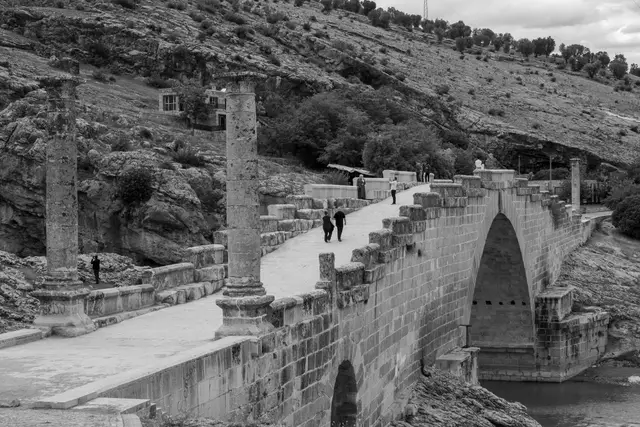
Carrying on from Karakuş, you reach the Roman bridge that rises over the Cendere stream on a single great arch. Locals call it the Roman Bridge or the Septimius Severus Bridge. It was built on the orders of Emperor Septimius Severus by the legion then stationed at Samsat. The columns at either end were dedicated to the imperial family; after Caracalla had his brother Geta killed, he had Geta's column removed, which is why one column is missing today. The inscriptions on the parapet record repairs made in the Roman period. Take a few minutes to walk across and look down into the valley.
Getting there
It is reached by private car or on a tour.
Source: Kültür Portalı · last checked 2026-10-22
Good to know
It was built on the orders of Roman Emperor Septimius Severus (AD 193–211) by the XVI Legion, then based at Samsat; it is 7 m wide, 30 m high and 120 m long.
Source: Kültür Portalı · last checked 2026-10-22
Tips
The bridge is in the open. The area is reached by private car or on a tour; watch out for traffic on the bridge.
Day 1 · 3 · 12:00–13:00
Yeni Kale (Kâhta Castle)
ClosedPerched on a steep crag above the village of Kocahisar, Yeni Kale faces the old fortress on the Arsameia hill directly across the valley. Its first construction goes back to the Commagene period, but what you see today dates from the Mamluk era. Inside the walls are water cisterns, a bath and the remains of a mosque; a hidden water passage running down to the Kâhta stream secured the supply in times of siege. The stairs and slopes are steep, so take the climb slowly. Looking from the top over the valley to Arsameia opposite, you can see why the two strongholds were built so close to each other.
Opening hours
Opens 08:00 and closes 19:00; the ticket office closes at 18:30.
Source: muze.gov.tr · last checked 2026-10-22
Closed
Open every day.
Source: muze.gov.tr · last checked 2026-10-22
Good to know
Its first construction goes back to Commagene; its present form is Mamluk. It has water cisterns, a bath, a mosque and a hidden water passage down to the Kâhta stream.
Source: Adıyaman İl Kültür ve Turizm Müdürlüğü · last checked 2026-10-22
Tips
The castle is open every day. Wear shoes with good grip. Between November and March, check the opening hours at the entrance; ask about the entry fee at the ticket office too.
Day 1 · 4 · 14:00–16:00
Arsameia archaeological site
ClosedAfter lunch, head up to Arsameia, the summer capital and seat of government of the Kingdom of Commagene. According to the inscription in the centre, it was founded by Arsames, a paternal ancestor of Antiochus I, while most of the remains you see today were built by Antiochus I himself. Relief stelae line the processional way; the most widely known shows the king shaking hands with a god. Further along are a monumental burial chamber cut into the rock, a long tunnel and the largest inscription in Anatolia. It carries the world view of a king who tried to bring Eastern and Western traditions together. Reading it here gives meaning to the statues you will see on Nemrut in the evening.
Opening hours
Opens 08:00 and closes 17:30; the ticket office closes at 17:00.
Source: muze.gov.tr · last checked 2026-10-22
Closed
Open every day.
Source: muze.gov.tr · last checked 2026-10-22
Good to know
It was the summer capital and seat of government of the Kingdom of Commagene.
Source: muze.gov.tr · last checked 2026-10-22
Good to know
It was discovered in 1951; along the processional way are relief stelae, a rock-cut monumental burial chamber, the largest inscription in Anatolia and a tunnel.
Source: GoTürkiye · last checked 2026-10-22
Tips
The site is open every day. The path is uneven; bring water and a hat. Between November and March, check the opening hours at the entrance; ask about the entry fee at the ticket office too.
Day 1 · 5
Mount Nemrut: the west terrace at sunset
Closed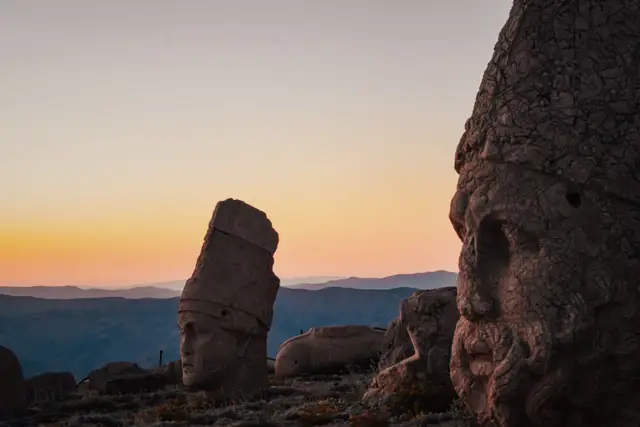
Climb to the summit of Nemrut in the last light of the day. Crushed stone was piled over the tomb built for King Antiochus I of Commagene to form a giant mound, and on the three terraces around it stand a fire altar, colossal statues blending Persian and Macedonian styles, and relief stelae. The west terrace is where people watch the sunset; the fallen heads of the statues turn orange in the evening light. The lion relief on this terrace carries a map of the sky and is regarded as one of the oldest astrological calendars in the world. The wind is strong at the top and the air cools quickly; be ready to walk down in the dark after sunset.
Closed
Open every day.
Source: muze.gov.tr · last checked 2026-10-22
Good to know
Opening hours may change according to sunrise and sunset.
Source: muze.gov.tr · last checked 2026-10-22
Good to know
It is a UNESCO World Heritage Site. A mound of crushed stone was raised over the tomb of King Antiochus I of Commagene; the three terraces around it hold a fire altar, colossal statues and relief stelae.
Source: muze.gov.tr · last checked 2026-10-22
Good to know
The lion relief on the west terrace shows the date 7 July 62 BC and is regarded as the world's oldest astrological calendar.
Source: GoTürkiye · last checked 2026-10-22
Tips
Opening hours can change with sunrise and sunset; check access times with the museum directorate before a sunset visit. Check road conditions for the season too. Bring warm clothes and a torch.


Day 2 · Sunrise on Nemrut and Perre
Go up to the summit in the dark for the sunrise, have breakfast in Kâhta and visit Perre on the way back to Adıyaman. Try Adıyaman's meatless çiğ köfte for lunch.
Day 2 · 1
Mount Nemrut: the east terrace at sunrise
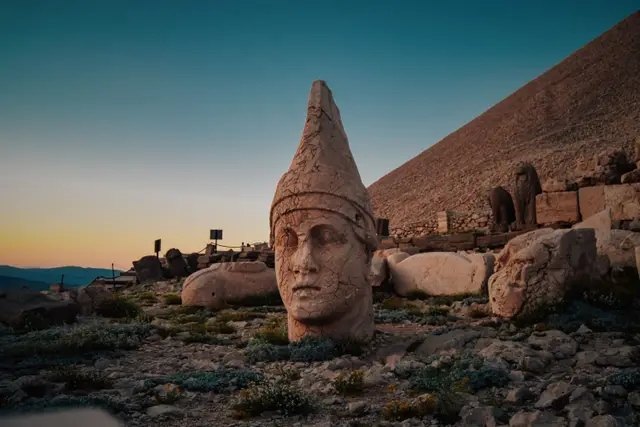
Start the second day in the dark: the east terrace of Nemrut is where people watch the sunrise. Here the colossal statues, made of limestone and sandstone blocks, show the king and the gods seated on their thrones. The long inscription behind the thrones, known as the Nomos, sets out the religious and social testament of Antiochus I; the king had the rules for keeping his cult alive written down here in detail. As the sun rises over the Euphrates basin, it slowly lights the terrace. Set beside the west terrace you saw in the evening, it completes the two faces of the monument.
Good to know
The east terrace is for sunrise and the west terrace for sunset; behind the thrones, the 234-line Nomos inscription is the religious and social testament of Antiochus I.
Source: GoTürkiye · last checked 2026-10-22
Good to know
The colossal statues, made of limestone and sandstone blocks, are 8–10 m high.
Source: GoTürkiye · last checked 2026-10-22
Tips
Check sunrise access times with the museum directorate before you go. The summit is cold in the morning; bring a coat, a hat and a hot drink.
Day 2 · 2 · 12:00–13:30
Ancient Perre
ClosedAfter breakfast in Kâhta, drive back to central Adıyaman and visit Perre at Örenli, just north of the city. Perre was one of the five great cities of the Kingdom of Commagene. Its place on the road between Malatya and Samsat gave it importance; armies and caravans stopped here for the water of its spring, which is still in use today. In the partly excavated necropolis you will see many burial chambers and galleries cut into the hillside. Beside the necropolis, traces of olive oil, wine and textile workshops tell of everyday life in the city. After the royal monuments of Nemrut, it is a good way to end with the world of ordinary people.
Opening hours
Opens 08:00 and closes 17:30; the ticket office closes at 17:00.
Source: muze.gov.tr · last checked 2026-10-22
Closed
Open every day.
Source: muze.gov.tr · last checked 2026-10-22
Good to know
It was one of the five great cities of the Kingdom of Commagene (163 BC – AD 72), on the road between Melitene (Malatya) and Samosata (Samsat).
Source: muze.gov.tr · last checked 2026-10-22
Good to know
The partly excavated necropolis has thousands of burial chambers and galleries, with olive oil, wine and textile workshops beside it.
Source: GoTürkiye · last checked 2026-10-22
Tips
The site is open every day. The Adıyaman Museum is closed because of the earthquake, so it is not part of the itinerary. Between November and March, check the opening hours at the entrance; ask about the entry fee at the ticket office too.

Getting around
Getting there
The Nemrut site is 87 km from the provincial centre by the direct road, 77 km via the ancient Arsameia road and 43 km from Kâhta.
Source: Adıyaman İl Kültür ve Turizm Müdürlüğü · last checked 2026-10-22
Good to know
The Adıyaman Museum is closed because of the earthquake.
Source: muze.gov.tr · last checked 2026-10-22
What and where to eat
What to eat and where to look
Adıyaman meatless çiğ köfte
Çiğ köfte shops in central Adıyaman
Source: GoTürkiye · last checked 2026-10-22
Hıtap (stone-oven flatbread with braised meat) and Adıyaman tava
Restaurants in the city centre
Source: GoTürkiye · last checked 2026-10-22
Meyir soup
Restaurants in Kâhta
Source: GoTürkiye · last checked 2026-10-22
Cheese halva, olive-oil baklava and şilke dessert
Dessert and baklava shops
Source: GoTürkiye · last checked 2026-10-22
Local specialities
Adıyaman meatless çiğ köfte
Meatless çiğ köfte registered with an indication of source in the name of the Adıyaman Chamber of Commerce and Industry.
Source: TÜRKPATENT Coğrafi İşaret · Geographical indication (reg. no 366) · last checked 2026-10-22
Kâhta almond
Almond registered with a designation of origin in the name of the Kâhta District Governorship.
Source: TÜRKPATENT Coğrafi İşaret · Geographical indication · designation of origin (reg. no 712) · last checked 2026-10-22
Adıyaman Besni grape
Grape registered with a designation of origin in the name of Besni Municipality.
Source: TÜRKPATENT Coğrafi İşaret · Geographical indication · designation of origin (reg. no 357) · last checked 2026-10-22
Opening hours and prices vary by venue; check the venue’s own site before you go. Recommendations are not paid placements.
Where to stay
Candidates were picked by distance to the area, star rating, guest rating (weighted by number of reviews) and completeness of hotel details. Ratings, review counts and details come live from our catalogue. Tiers follow the star rating.
Sample dates: 26.11–27.11 (1 night), 2 adults. Prices change with dates; choose your own dates on the hotel page.
Kâhta
It is 43 km from Nemrut and the starting point of the Karakuş, Cendere, Yeni Kale and Arsameia route.
Good for: Families travelling by car
Budget


Central Adıyaman
Close to Perre; convenient for city services and the journey home.
Good for: Those continuing to Şanlıurfa or Gaziantep
Budget


Photos: Pexels (Mehmet Turgut Kirkgoz, dilan archive, SERHAT TUĞ)
