Self-guided itinerary · free
Athens in 3 days: the Acropolis, the Ancient Agora and Lycabettus
The programme splits the ancient core of Athens into three walking clusters; you only need public transport on day three, to reach the museum. Day one covers the Acropolis, the Acropolis Museum and the lanes of Plaka and Anafiotika; day two is the lower town, with the Ancient Agora, Monastiraki, the changing of the guard at Syntagma, the Olympieion and the Panathenaic Stadium; day three brings the National Archaeological Museum, Kolonaki and Lycabettus Hill at sunset. Archaeological sites keep different summer and winter hours; the plan follows winter hours and puts time-limited sites in the morning or early afternoon. Prices and opening hours come from official sources with the date they were last checked, and where something could not be verified we point you to the official site. Three walkable districts are suggested for your stay.
Prepared by: Kolay Seyahat content teamLast updated 22/10/2026Every fact links to an official source

This is not a package tour. This itinerary is free information. Flights, hotels and experiences are each sold separately, under their own seller’s terms, with separate payment and a separate contract. Prices are never linked to one another.
Day by day
Progress is saved on this device only. Your location is never sent.
Day 1 · The Acropolis, the Acropolis Museum and Plaka
Start at the Acropolis as it opens, follow the pedestrian street down the south slope to the Acropolis Museum, and spend the afternoon in the narrow lanes of Plaka and Anafiotika. The whole day is on foot.
Day 1 · 1 · 08:00–10:30
The Acropolis
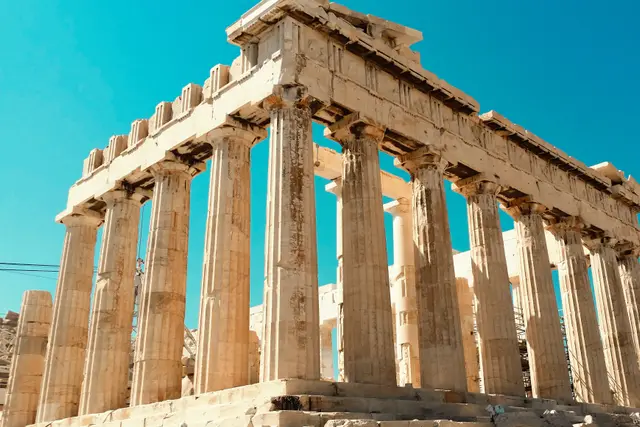
The rock that symbolises Athens brings the masterpieces of Classical Greek architecture together on a single hill. The Parthenon, the Propylaia, the Erechtheion and the Temple of Athena Nike were built in the second half of the 5th century BC, in the age of Pericles. The rock rises about 150 metres above sea level, and the Caryatids, the female figures standing in for columns on the Erechtheion's south porch, are the most photographed detail. Going up at opening time lets you see it before the crowds build.
Getting there
- Walk
Good to know
The rock stands about 150 m above sea level; the Caryatids are on the Erechtheion's south porch.
Source: This is Athens (Atina Belediyesi resmî ziyaretçi rehberi) · last checked 2026-10-22
Tips
Opening and closing times and ticket prices change with the season; check them on the Greek Ministry of Culture's official ticketing service before you go, and read the site rules at the entrance.
Day 1 · 2 · 10:45–13:30
The Acropolis Museum
ClosedBooking recommendedThe Dionysiou Areopagitou pedestrian street that comes down from the Acropolis brings you straight to the museum's door. The museum shows the finds from the Acropolis right at the foot of the rock, and the excavation beneath the building is included in the same ticket. Coming here after the Acropolis lets you study up close what you saw on the hill. The pedestrian street linking the museum and the monuments has also made the surrounding Makrygianni–Koukaki district one of the city's most popular areas.
Getting there
- Walk
Opening hours
Winter (1 Nov–31 Mar): Mon–Thu 09:00–17:00, Fri 09:00–22:00, Sat–Sun 09:00–20:00. Summer (1 Apr–31 Oct): Mon 09:00–17:00, Tue–Sun 09:00–20:00, Fri 09:00–22:00. Last entry 30 minutes before closing.
Source: Akropolis Müzesi · last checked 2026-10-22
Closed
Closed 1 January, Orthodox Easter Sunday, 1 May and 25–26 December; 24 and 31 December 09:00–15:00.
Source: Akropolis Müzesi · last checked 2026-10-22
Entrance fee
General admission €20, reduced €10. The ticket also covers the excavation beneath the museum.
Source: Akropolis Müzesi · last checked 2026-10-22
Tickets and booking
Tickets are sold at the desk or through the museum's e-ticket service; reduced and free tickets only at the desk.
Source: Akropolis Müzesi · last checked 2026-10-22
Tips
Buy tickets only from the museum's own website or at the ticket desk; the museum warns against fake ticketing sites posing as official. Reduced tickets are issued only at the desk, on proof of eligibility.
Day 1 · 3 · 15:00–16:30
Plaka, Anafiotika and the Lysicrates Monument
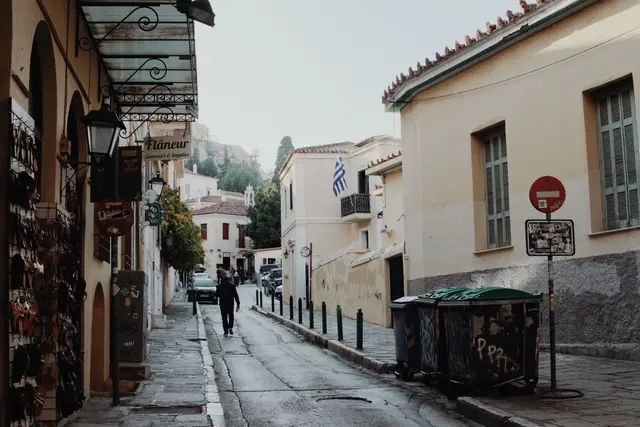
After lunch, head into Plaka at the foot of the Acropolis. The district runs from Filomousson Square to Monastiraki and keeps the oldest street pattern in Athens. Higher up, right under the rock, Anafiotika was built by workers from the island of Anafi, and its whitewashed houses and narrow steps feel like an island village. Your route also passes the Lysicrates Monument in a small square ringed by cafés. Anafiotika is still a lived-in neighbourhood, so keep your voice down and do not gather in front of people's doors.
Getting there
- Walk
Good to know
Anafiotika was built by workers from the island of Anafi; Plaka stretches from Filomousson Square to Monastiraki.
Source: This is Athens (Atina Belediyesi resmî ziyaretçi rehberi) · last checked 2026-10-22
Tips
Anafiotika is roughly bounded by two 17th-century churches: Agios Georgios tou Vrachou to the east and Agios Simeon to the west. You can stay in Plaka for dinner.


Day 2 · The Ancient Agora, Syntagma, the Olympieion and the Panathenaic Stadium
A day in the lower town: start at the Ancient Agora in the morning, walk via Monastiraki to Syntagma and watch the changing of the guard, held on the hour. The Olympieion closes early in the afternoon in winter, so go straight after lunch, then end the day at the Panathenaic Stadium. On a Sunday, plan around the big ceremony at 11:00.
Day 2 · 1 · 08:30–10:45
The Ancient Agora, the Stoa of Attalos and the Temple of Hephaestus
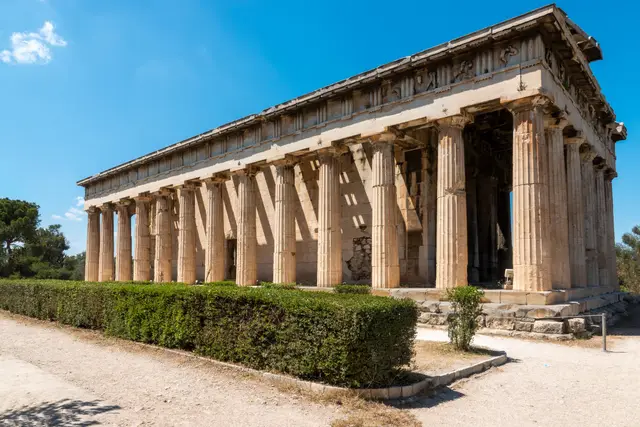
The Agora, the political and commercial heart of ancient Athens, was founded in the 6th century BC. The Stoa of Attalos, built by a king of Pergamon, now serves as a museum for the finds from the site. On the hill, the Hephaisteion, popularly called the Theseion, is a Doric temple from the 5th century BC. The Altar of the Twelve Gods was the point from which distances from Athens were measured in antiquity. Seeing the Acropolis from below, from the Agora, rounds off yesterday's visit.
Getting there
- Walk
Good to know
The Agora was founded in the 6th century BC; the Stoa of Attalos was built by a king of Pergamon. Address: 24 Adrianou, Monastiraki.
Source: This is Athens (Atina Belediyesi resmî ziyaretçi rehberi) · last checked 2026-10-22
Tips
The entrance is at 24 Adrianou Street, Monastiraki. Check hours and prices on the Greek Ministry of Culture's official ticketing service before you go; the ticket covers both the site and the Agora Museum.
Day 2 · 2 · 10:45–11:30
Monastiraki and the Roman Agora
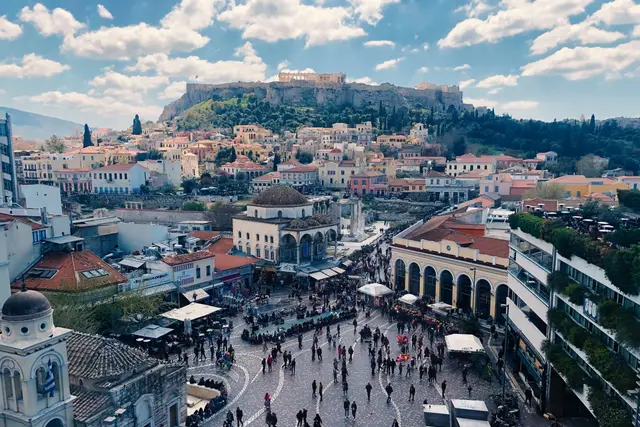
Walk along Adrianou Street to Monastiraki Square. The square and the streets around it are packed with shops, and the metro station is right here. Nearby, the Roman Agora and the Tower of the Winds are seen from outside, along the fence, in this programme; on a busy day it is an easy way to read the city's layers at a glance.
Getting there
- Walk
Tips
Check the Roman Agora's hours and prices on the official ticketing service. In crowded squares, keep your bag in front of you.
Day 2 · 3 · 11:45–12:15
Syntagma Square and the Tomb of the Unknown Soldier
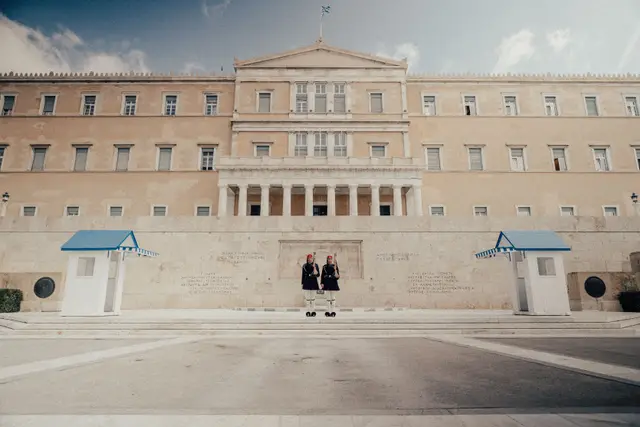
Walk along Ermou Street to Syntagma Square in front of the Parliament building. The Tomb of the Unknown Soldier in front of the building was unveiled on Greek Independence Day in 1932. Two guards from the Evzone unit stand watch, and the guard is changed in a formal ceremony. At the big ceremony on Sunday morning, the whole Presidential Guard marches to the memorial with a band.
Getting there
- Walk
Opening hours
The guard changes every hour on the hour; the fullest ceremony is on Sunday at 11:00 with the whole Presidential Guard.
Source: This is Athens (Atina Belediyesi resmî ziyaretçi rehberi) · last checked 2026-10-22
Good to know
The memorial was unveiled on Greek Independence Day in 1932.
Source: This is Athens (Atina Belediyesi resmî ziyaretçi rehberi) · last checked 2026-10-22
Tips
The guard changes on the hour; arriving at 11:45 gives you an easy view of the 12:00 change. Syntagma and Plaka are within walking distance for lunch.
Day 2 · 4 · 13:45–14:40
The Olympieion (Temple of Olympian Zeus)
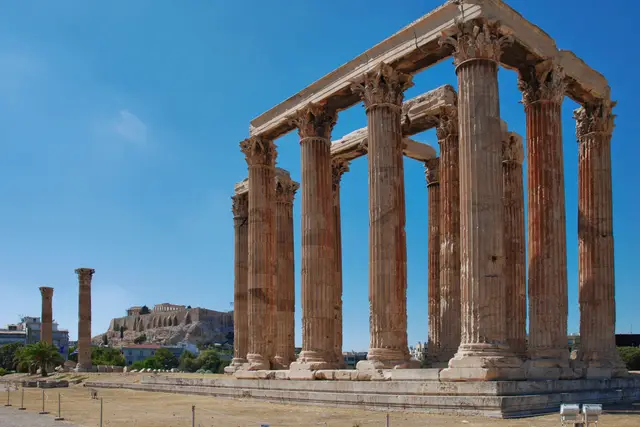
Skirt the edge of the National Garden and walk to the Olympieion. The largest ancient temple on the Greek mainland measured about 100 by 50 metres; work began in the 6th century BC and was finished only under the Roman emperor Hadrian. Fifteen of its 104 columns still stand and one lies on the ground, letting you see the temple's scale up close. Afterwards, pass Hadrian's Arch on your way to the stadium.
Getting there
- Walk
Good to know
The largest ancient temple on the Greek mainland (about 100 × 50 m); 15 of its 104 columns stand and one lies on the ground.
Source: This is Athens (Atina Belediyesi resmî ziyaretçi rehberi) · last checked 2026-10-22
Tips
The site closes early in the afternoon in winter, which is why it comes straight after lunch in this plan. Check current hours and prices on the official ticketing service.
Day 2 · 5 · 15:00–16:15
The Panathenaic Stadium (Kallimarmaro)
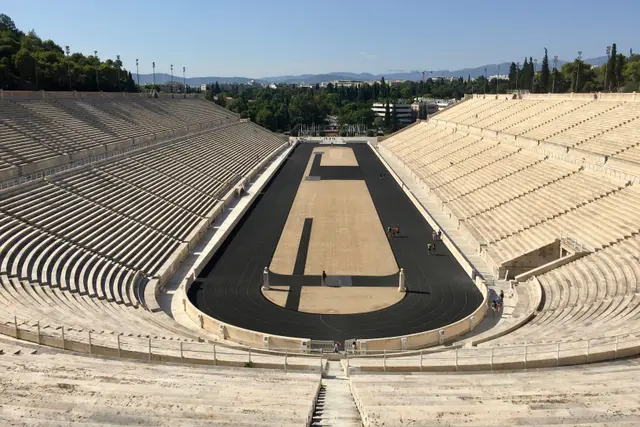
The last stop of the day is the Panathenaic Stadium, also known as Kallimarmaro. Lycurgus had it built in the 4th century BC, and in Roman times Herodes Atticus rebuilt it with marble tiers. The first modern Olympic Games were held here in 1896, and today it is the finish line of the Athens Marathon. Sitting on the tiers and looking out over the track is a good way to rest at the end of a full day.
Getting there
- Walk
Opening hours
Open daily 08:00–19:00.
Source: Panathinaiko Stadı · last checked 2026-10-22
Good to know
The first modern Olympic Games were held here in 1896; today it is the finish line of the Athens Marathon. Address: Vasileos Konstantinou Avenue, Pangrati.
Source: This is Athens (Atina Belediyesi resmî ziyaretçi rehberi) · last checked 2026-10-22
Tips
The track is sometimes closed to visitors for events; check the notices on the stadium's official site before you go, and find the current price there too. The Pangrati district is a short walk away for the evening.


Day 3 · The National Archaeological Museum, Kolonaki and Lycabettus
A day to the north: spend the morning at the National Archaeological Museum, wander Kolonaki in the afternoon and end on Lycabettus Hill at sunset. The museum opens late on Tuesdays; if day three falls on a Tuesday, do Kolonaki in the morning and the museum in the afternoon.
Day 3 · 1 · 08:30–11:30
The National Archaeological Museum
Athens' great archaeology museum, with its many galleries, easily fills a morning. Construction began in 1866 to a design by Ludwig Lange and was completed by Ernst Ziller in 1889; the exhibition space covers about 8,000 square metres. After two days at the ancient sites, this is your chance to look at the objects up close. Rather than trying to see every gallery, focusing on a few sections that interest you makes the visit more enjoyable.
Good to know
Building began in 1866 to Ludwig Lange's design and Ernst Ziller completed it in 1889; about 8,000 m² of exhibition space.
Source: This is Athens (Atina Belediyesi resmî ziyaretçi rehberi) · last checked 2026-10-22
Tips
Opening hours vary by day and season and are different on Tuesdays; check hours and prices with the official source before you go. The nearest metro stations are Omonia and Victoria.
Day 3 · 2 · 13:30–15:30
Kolonaki
After lunch, cross to Kolonaki at the foot of Lycabettus. With its shops and cafés, the district makes a good break for shopping and a rest. This is the most open part of the programme: browse the shop windows, sit in a café and rest, or drift slowly uphill towards the summit.
Getting there
- Walk
Tips
From Kolonaki, steep streets and steps lead up to Lycabettus; wear comfortable shoes.
Day 3 · 3 · 16:00–17:30
Lycabettus Hill
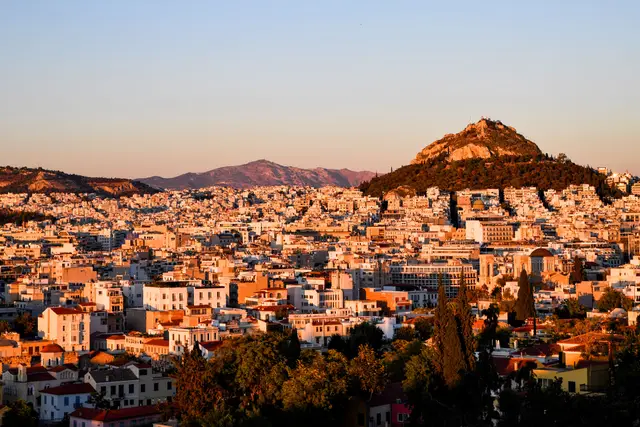
Finish the programme above the city on Lycabettus Hill. At 277 metres it is one of the highest viewpoints in greater Athens, with a wide panorama over the city. You can go up by funicular or on foot by paths and steps. Watching the sunset beside the Church of Agios Georgios at the summit closes your three days high above the city.
Getting there
- Walk
Good to know
277 m high; reached by funicular or on foot by steps.
Source: This is Athens (Atina Belediyesi resmî ziyaretçi rehberi) · last checked 2026-10-22
Tips
Check the funicular's hours and fares in advance; if you are walking up, set off at least an hour before sunset. Alternatively, you could spend this afternoon at the Temple of Poseidon at Sounion; plan transport and hours in advance with official sources.

Getting around
Getting there
Athens International Airport is 33 km south-east of the city. The X95 express bus runs 24 hours to Syntagma (about 60 minutes); the suburban railway reaches Larissis station in about 45 minutes. Taxis wait at exit 3.
Source: This is Athens (Atina Belediyesi resmî ziyaretçi rehberi) · last checked 2026-10-22
Getting there
Tap2Ride: pay by tapping a contactless Visa/Mastercard or phone on the validator. The metro runs daily 05:00–24:00; lines 2 and 3 until 02:00 on Fridays and all night on Saturdays.
Source: This is Athens (Atina Belediyesi resmî ziyaretçi rehberi) · last checked 2026-10-22
Entrance fee
Airport express bus single €5.50 (children, young people and over-65s €2.70). Fixed taxi fare airport–centre €40 from 05:00 to 24:00 and €55 from 24:00 to 05:00.
Source: This is Athens (Atina Belediyesi resmî ziyaretçi rehberi) · last checked 2026-10-22
Entrance fee
City single ticket €1.20 (90 minutes on all transport except the airport); daily ticket €4.10; 3-day tourist ticket €20 (unlimited travel plus one airport return). Metro airport ticket €9.
Source: This is Athens (Atina Belediyesi resmî ziyaretçi rehberi) · last checked 2026-10-22
Good to know
Emergency numbers: European emergency line 112, police 100, tourist police 1571 (English, French, German), ambulance 166, fire brigade 199.
Source: This is Athens (Atina Belediyesi resmî ziyaretçi rehberi) · last checked 2026-10-22
Good to know
Turkish Embassy in Athens: Vasileos Georgiou B' 11, 10674 Athens; tel. +30 210 726 30 00, emergency +30 690 986 34 66.
Source: T.C. Atina Büyükelçiliği · last checked 2026-10-22
What and where to eat
Recommended places
Zohós
Syntagma–Plaka, Navarchou NikodimouTraditional Greek cooking
MICHELIN Guide Bib Gourmand; the guide describes a calm stop with indoor and outdoor seating in a hotel courtyard. An easy walk from Plaka on the evening of day one.
Source: MICHELIN Guide · MICHELIN Guide · last checked 2026-10-22
Nolan
Syntagma, Voulis StreetFusion
MICHELIN Guide Bib Gourmand; the guide notes its menu blending Greek cooking with other cuisines. Close by for lunch at Syntagma on day two.
Source: MICHELIN Guide · MICHELIN Guide · last checked 2026-10-22
Akra
PangratiGreek cooking
MICHELIN Guide Bib Gourmand; according to the guide, the chef cooks over a wood grill in front of guests at the counter. For the evening of day two, after the stadium.
Source: MICHELIN Guide · MICHELIN Guide · last checked 2026-10-22
Pharaoh
Near Exarchia, Solomou StreetGreek cooking
MICHELIN Guide Bib Gourmand; according to the guide there is no modern stove, and dishes are cooked the old way over a wood fire. Close to the museum for lunch on day three.
Source: MICHELIN Guide · MICHELIN Guide · last checked 2026-10-22
Glykis Kafenio
PlakaTraditional kafeneio and meze
The city's official visitor guide describes it as an old-style kafeneio; a good Plaka stop on day one for Greek coffee and simple meze.
Source: This is Athens (Atina Belediyesi resmî ziyaretçi rehberi) · Official tourism source · last checked 2026-10-22
Vassilenas
PangratiFish and Greek cooking
According to the city's official visitor guide, its taramasalata made to the founder's recipe stands out.
Source: This is Athens (Atina Belediyesi resmî ziyaretçi rehberi) · Official tourism source · last checked 2026-10-22
Local specialities
Taramasalata
A pink dip made with fish roe; the city's official visitor guide lists it among the classic tastes of Athens.
Source: This is Athens (Atina Belediyesi resmî ziyaretçi rehberi) · Official tourism source · last checked 2026-10-22
Tzatziki
Listed by the city's official visitor guide among the classic Greek dips.
Source: This is Athens (Atina Belediyesi resmî ziyaretçi rehberi) · Official tourism source · last checked 2026-10-22
Feta
According to the guide, Greeks put feta on the table at almost every meal, with olive oil and oregano.
Source: This is Athens (Atina Belediyesi resmî ziyaretçi rehberi) · Official tourism source · last checked 2026-10-22
Hortopita
A pie filled with greens.
Source: This is Athens (Atina Belediyesi resmî ziyaretçi rehberi) · Official tourism source · last checked 2026-10-22
Lahanodolmades
Fillings wrapped in cabbage leaves, a cousin of the stuffed cabbage of Turkish cooking.
Source: This is Athens (Atina Belediyesi resmî ziyaretçi rehberi) · Official tourism source · last checked 2026-10-22
Atherina
Tiny fried sand smelt, eaten with your fingers and a squeeze of lemon.
Source: This is Athens (Atina Belediyesi resmî ziyaretçi rehberi) · Official tourism source · last checked 2026-10-22
Galaktoboureko
A syrup-soaked dessert with semolina custard.
Source: This is Athens (Atina Belediyesi resmî ziyaretçi rehberi) · Official tourism source · last checked 2026-10-22
Opening hours and prices vary by venue; check the venue’s own site before you go. Recommendations are not paid placements.
Where to stay
Candidates were picked by distance to the area, star rating, guest rating (weighted by number of reviews) and completeness of hotel details. Ratings, review counts and details come live from our catalogue. Tiers follow the star rating.
Sample dates: 26.11–28.11 (2 nights), 2 adults. Prices change with dates; choose your own dates on the hotel page.
Plaka – Syntagma
The Acropolis and Plaka on day one and Syntagma and the Olympieion on day two are all within walking distance, and the X95 airport bus stops at Syntagma.
Good for: First-time visitors and couples
Budget


Mid-range


Makrygianni – Koukaki
The Acropolis Museum and the pedestrian street up to the monuments are on the doorstep, and the 3-day tourist ticket is sold at Acropolis metro station.
Good for: Travellers who want a quieter base and to get around on foot
Budget


Mid-range


Monastiraki – Psyrri
The Ancient Agora is within walking distance, and Monastiraki and Thissio stations sell the tourist ticket.
Good for: Younger travellers who want lively evenings
Budget


Mid-range


Photos: Pexels (José Barbosa, Kevin Lee, Shir Danieli, Bob Jenkin, Matheus Bertelli, Tom D'Arby, Ali Menoufi, Margo Evardson)
