Self-guided itinerary · free
Safranbolu and Amasra in 2 days: the old bazaar, mansions and castle
Safranbolu has been protected since 1975 and on the UNESCO World Heritage List since 1994; this plan spreads its timber-house bazaar quarter and Amasra on the western Black Sea coast over two days. On day one you look over the town from Hıdırlık Hill, then walk to Kazdağlı Square, the Cinci Inn, the Yemeniciler Arasta, Kaymakamlar House and the City History Museum with its Clock Tower, with an optional late-afternoon walk into Tokatlı Canyon. On day two you visit Yörük Village, then drive to Amasra for its castle, the Kemere Bridge and the Amasra Museum. The City History Museum and the Amasra Museum close on Mondays, so plan the trip between Tuesday and Sunday.
Prepared by: Kolay Seyahat content teamLast updated 22/10/2026Every fact links to an official source

This is not a package tour. This itinerary is free information. Flights, hotels and experiences are each sold separately, under their own seller’s terms, with separate payment and a separate contract. Prices are never linked to one another.
Day by day
Progress is saved on this device only. Your location is never sent.
Day 1 · Safranbolu’s old bazaar: Hıdırlık, inns, the arasta and museums
Look over the town from Hıdırlık Hill, walk down via Kazdağlı Square and the Cinci Inn into the bazaar, then visit Kaymakamlar House and the City History Museum in the afternoon. The museum is closed on Mondays, so this day should not fall on a Monday.
Day 1 · 1 · 08:30–09:30
Hıdırlık Hill
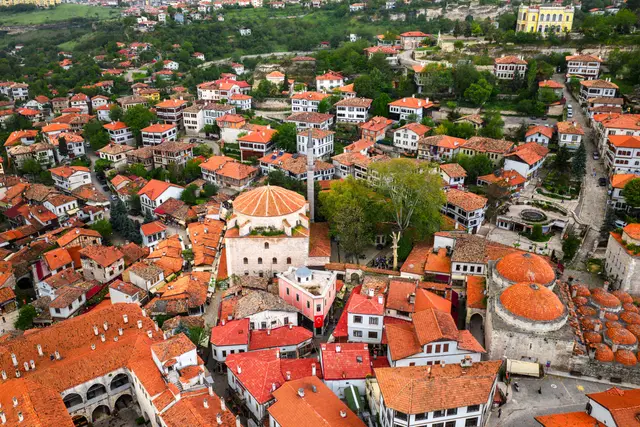
Start the day by seeing the town from above. Hıdırlık Hill rises at the entrance to Safranbolu on the road from Kastamonu, and from here the red-tiled roofs of the old bazaar quarter and the timber houses stacked against the valley come into view at once. According to the municipality, this is where the first Turks to arrive in Safranbolu settled, and where rain prayers and Hıdırellez celebrations were held. On the hill stand the tomb of Hasan Pasha, governor of Köstendil, the shrine of Hızır Pasha, the memorial grave of Dr. Ali Yaver Ataman, a well-known figure of the War of Independence, and two open-air prayer platforms. Morning light picks out the bay windows and chimneys of the houses, and getting your bearings here makes the rest of the walk much easier.
Getting there
- Walk
Good to know
Hıdırlık is where the first Turks to arrive in Safranbolu settled and where rain prayers and Hıdırellez celebrations were held; on the hill are the tomb of Hasan Pasha (1845), the shrine of Hıdır Pasha, the memorial grave of Dr. Ali Yaver Ataman (1955) and two open-air prayer platforms.
Source: Safranbolu Belediyesi · last checked 2026-10-22
Tips
You can walk up from the bazaar quarter and come back down the same way. Keep your voice low around the graves.
Day 1 · 2 · 09:45–10:45
Kazdağlı Square and the Cinci Inn
Kazdağlı Square is the natural place to begin a walk through the historic centre, and the Cinci Inn beside it is one of the buildings that most directly tells the story of Safranbolu as a stop on the caravan routes. Built in the mid-17th century of cut stone and rubble by Cinci Hoca, a chief judge of Anatolia under Sultan İbrahim, the inn has two storeys, 63 rooms and a pool in the middle of its courtyard. Its entrance door, lock and key are cited as examples of Turkish ironwork. From the roof terrace the roofs and minarets of the bazaar quarter spread out in a panorama. The nearby Cinci Hamam was also built in 1645; it has separate sections for women and men and still works as a bathhouse today.
Getting there
- Walk
Good to know
The Cinci Inn was built in the mid-17th century of cut stone and rubble by Cinci Hoca (Chief Judge Hüseyin Efendi); it has two storeys, 63 rooms and a pool in its courtyard. The Cinci Hamam was built in 1645 and is still in use.
Source: Safranbolu Belediyesi · last checked 2026-10-22
Good to know
A walk through the historic centre can start at Kazdağlı Square; the roof terrace of the Cinci Inn gives a panoramic view of the town.
Source: Safranbolu Belediyesi · last checked 2026-10-22
Tips
The inn and the bathhouse are run as businesses; ask at the door about access to the terrace and the bathhouse.
Day 1 · 3 · 10:45–12:00
The Yemeniciler Arasta, the Blacksmiths’ Bazaar and the Köprülü Mehmet Pasha Mosque
The narrow streets behind the inn lead into the bazaar quarter. The Yemeniciler Arasta is a row of 48 timber shops side by side; once the place where the leather slippers called yemeni were made, it is now full of small shops selling crafts and souvenirs. A little further on, the Blacksmiths’ Bazaar keeps its Ottoman look, and its handmade copperware stands out. In the same area, the Köprülü Mehmet Pasha Mosque was built in 1661–1662 by Grand Vizier Köprülü Mehmet Pasha; the sundial in its courtyard marks the time in ten-minute intervals with Arabic numerals. The İzzet Mehmet Pasha Mosque, built in 1796, is considered a small version of the Nuruosmaniye Mosque in Istanbul.
Getting there
- Walk
Good to know
The Yemeniciler bazaar consists of 48 timber shops side by side; the Köprülü Mehmet Pasha Mosque was built in 1661/1662 and the sundial in its courtyard shows the time in 10-minute intervals; the İzzet Mehmet Pasha Mosque dates from 1796.
Source: GoTürkiye · last checked 2026-10-22
Tips
Enter the mosques outside prayer times; modest dress and quiet are expected. Visit the Blacksmiths’ Bazaar in the morning to see the copperwork.
Day 1 · 4 · 13:30–14:30
Kaymakamlar House
After lunch it is time to step inside a Safranbolu house. Kaymakamlar House is one of the important examples of 18th- and 19th-century Safranbolu houses and is thought to date from the early 19th century. It takes its name from the title kaim-makam, or lieutenant colonel, given to its owner Hacı Mehmet Efendi, commander of the Safranbolu barracks. The Ministry of Culture expropriated and restored the house in 1979, and today it is visited as a house museum. Carved wooden ceiling roses, built-in cupboards and divans in the rooms show how the house was arranged around winter and summer life; climbing from the courtyard to the upper floors, it is easy to picture how it housed a large family.
Getting there
- Walk
Good to know
Kaymakamlar House is a Safranbolu house thought to date from the early 19th century; the Ministry of Culture expropriated and restored it in 1979, and it is used today as a house museum.
Source: Safranbolu Belediyesi · last checked 2026-10-22
Tips
Check opening times and the fee at the entrance.
Day 1 · 5 · 14:45–16:15
The City History Museum and the Clock Tower
ClosedThe stone Old Government House on the castle hill is now home to the City History Museum, which tells Safranbolu’s story. According to its entrance inscription, the building was put up in 1904 through the efforts of Enis Pasha, governor of Kastamonu, and district governor Mir Ahmet Bey, with contributions from the townspeople; it was restored in the 2000s and turned into a museum. Inside, sections cover the town’s crafts, trade and daily life. Beside the museum, the Clock Tower was built in 1797 by İzzet Mehmet Pasha, the Safranbolu-born grand vizier of Sultan Selim III. The square tower can be visited as part of the museum, and the open-air area beside it displays fifteen miniature clock towers, fourteen from Türkiye and one from Bosnia and Herzegovina.
Getting there
- Walk
Opening hours
Opens 08:30, closes 17:00; the ticket office closes at 16:30.
Source: T.C. Kültür ve Turizm Bakanlığı (muze.gov.tr) · last checked 2026-10-22
Closed
Closed on Mondays.
Source: T.C. Kültür ve Turizm Bakanlığı (muze.gov.tr) · last checked 2026-10-22
Good to know
The museum is housed in the stone Old Government House on the castle hill, built in 1904 according to its entrance inscription.
Source: T.C. Kültür ve Turizm Bakanlığı (muze.gov.tr) · last checked 2026-10-22
Good to know
The Clock Tower was built in 1797 by Grand Vizier İzzet Mehmet Pasha; it can be visited as part of the City History Museum, and 15 miniature clock towers are displayed beside it.
Source: Safranbolu Belediyesi · last checked 2026-10-22
Tips
The museum is closed on Mondays, so do not plan this day for a Monday. The ticket office closes at 16:30. The listed hours do not vary by season; between November and March, check the hours at the entrance.
Day 1 · 6 · 16:30–18:00
Optional: the İncekaya Aqueduct and Tokatlı Canyon
If you have the daylight and the energy, spend the late afternoon in Tokatlı Canyon. One end of the canyon is at Tokatlı village and the other at the Gümüş quarter of the old bazaar, with a 9-kilometre walking trail between them; you do not need to walk it all, as even a short stretch gives a sense of the canyon’s depth. Descending into the canyon, the İncekaya Aqueduct on your left is 116 metres long with six arches, and Tokatlı Stream flows beneath it. The sight of the stone arches joining the two sides of the canyon is a reminder that Safranbolu is more than its timber houses. On the way back you can walk down to the bazaar quarter for dinner.
Getting there
- Walk
Good to know
The İncekaya Aqueduct is 116 m long with 6 arches; Tokatlı Stream flows beneath it.
Source: Safranbolu Belediyesi · last checked 2026-10-22
Good to know
One end of Tokatlı Canyon is at Tokatlı village and the other at the Gümüş quarter of the old bazaar; there is a 9 km walking trail, and there is no charge for entering from the old bazaar side.
Source: Safranbolu Belediyesi · last checked 2026-10-22
Tips
The path gets slippery in the rain; skip this stop if it is wet. Wear suitable shoes.

Day 2 · Yörük Village and Amasra
Visit Yörük Village in the morning, then drive to Amasra for the castle, the Kemere Bridge and the Amasra Museum. The Amasra Museum is closed on Mondays, so this day should not fall on a Monday either.
Day 2 · 1 · 08:30–10:00
Yörük Village
Begin the second day at Yörük Village, eleven kilometres outside Safranbolu. The Ministry of Culture placed the village, on the Safranbolu–Araç road, under protection in 1997, and the municipality describes it as a small model of Safranbolu; it has 93 listed buildings. Once the seat of the Ottoman district of Yörükan-ı Taraklıborlu, the village with its stone-based, timber-framed houses, communal laundry and fountains lets you see the same architecture in a quieter setting than the bazaar quarter. Mornings are calm here; as you walk the lanes, remember that many of the houses are still lived in.
Good to know
Yörük Village is 11 km from Safranbolu; the Ministry of Culture placed it under protection in 1997 and it has 93 listed buildings.
Source: Safranbolu Belediyesi · last checked 2026-10-22
Tips
If you prefer a cave, you can visit Bulak Mencilis Cave instead of this stop; check opening times and the fee at the entrance. Do not enter private gardens in the village without permission.
Day 2 · 2 · 13:00–15:00
Amasra Castle, the Kemere Bridge and the Fatih Mosque
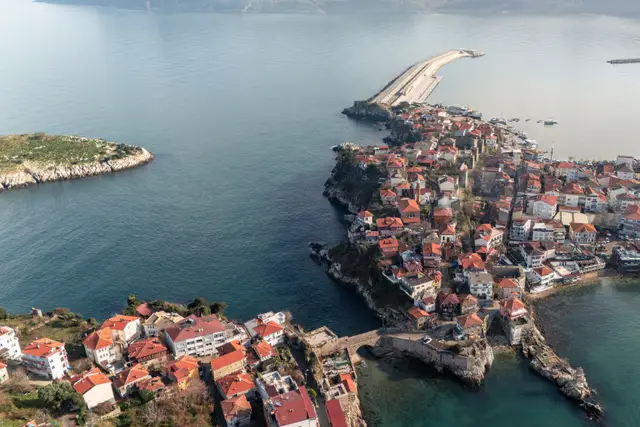
Drive north to Amasra on the western Black Sea coast and, after lunch, head up to the castle. Amasra Castle was built in the Byzantine period and saw major repairs under the Genoese and the Ottomans. It has two main parts: Sormagir Castle on Boztepe and Zindan Castle in Amasra itself. Sormagir is joined to the mainland by the Kemere Bridge, and the arched main gate beside the bridge is known as Karanlık Yer, the dark place. Inside the castle, the Fatih Mosque is a 9th-century Byzantine church converted into a mosque in 1460. From the walls you can see both bays, Küçükliman and Büyükliman, at once, and it is easy to see why the town grew up between two natural harbours.
Good to know
Amasra Castle was built in the Byzantine period and repaired under the Genoese and the Ottomans; it consists of Sormagir Castle on Boztepe and Zindan Castle in Amasra. Sormagir is joined to the mainland by the Kemere Bridge. The Fatih Mosque is a 9th-century Byzantine church converted into a mosque in 1460.
Source: GoTürkiye · last checked 2026-10-22
Tips
Check the driving time from Safranbolu to Amasra on a map before you set off. Enter the mosque outside prayer times.
Day 2 · 3 · 15:15–16:15
Amasra Museum
ClosedWalk down from the castle to the Kum quarter for the Amasra Museum. It occupies the building of a naval school begun in 1884 and never finished; the ministry restored the building in 1976 and the museum opened in 1982. Finds from the Hellenistic and Roman periods through the Byzantine, Genoese and Ottoman eras are shown in four halls, two for archaeology and two for ethnography. The garden holds sarcophagi, gravestones, altars, Ottoman cannons and anchors. Following through these objects the layers you saw at the castle is a good way to pull the town’s long history together.
Getting there
- Walk
Opening hours
Opens 08:30, closes 20:00; the ticket office closes at 19:30.
Source: T.C. Kültür ve Turizm Bakanlığı (muze.gov.tr) · last checked 2026-10-22
Closed
Closed on Mondays.
Source: T.C. Kültür ve Turizm Bakanlığı (muze.gov.tr) · last checked 2026-10-22
Entrance fee
€4 (muze.gov.tr English page; check the lira amount at the ticket office).
Source: T.C. Kültür ve Turizm Bakanlığı (muze.gov.tr) · last checked 2026-10-22
Good to know
The museum is in a naval school building begun in 1884 but never finished; it was restored in 1976 and opened as a museum in 1982; it has two archaeology and two ethnography halls.
Source: T.C. Kültür ve Turizm Bakanlığı (muze.gov.tr) · last checked 2026-10-22
Tips
The museum is closed on Mondays, so do not plan this day for a Monday. The listed hours do not vary by season; between November and March, check the hours at the entrance.
Day 2 · 4 · 16:30–18:00
The Küçükliman and Büyükliman shore
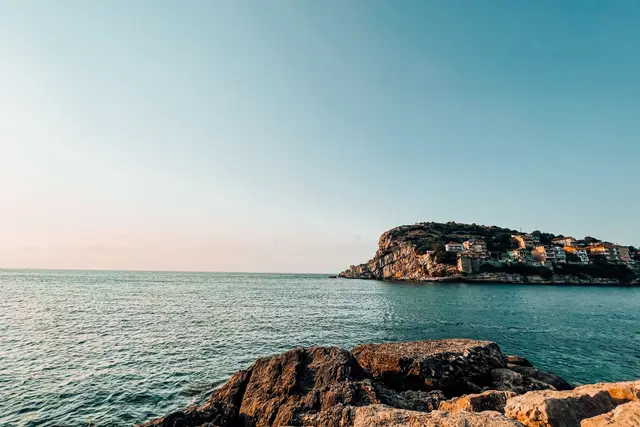
End the day on the shore of the two harbours. Amasra appears in historical sources as Sesamos; its story runs from a Phoenician trading colony through the Ionian, Lydian, Persian, Hellenistic, Roman, Byzantine and Genoese periods to Ottoman rule in 1460. It is said that Sultan Mehmed II looked down on the town from Bakacak Hill and called it Çeşm-i Cihan, the eye of the world; the hill is known today as Çeşm-i Cihan Hill. Walking along the shore in the late-afternoon light, looking at the fishing boats and the island, makes a calm close before the journey back.
Getting there
- Walk
Good to know
Amasra appears in historical sources as Sesamos; after a history that began as a Phoenician trading colony, it came under Ottoman rule in 1460. Bakacak Hill is known today as Çeşm-i Cihan Hill.
Source: Amasra Belediyesi · last checked 2026-10-22
Tips
If you have a long drive back, leave before sunset; check transport or road conditions in advance.


Getting around
Getting there
Safranbolu is 8 km north of the provincial centre of Karabük.
Source: GoTürkiye · last checked 2026-10-22
Good to know
Safranbolu has been protected since 1975 and was added to the UNESCO World Heritage List in 1994; about 800 of its roughly 2,000 traditional houses are legally protected.
Source: GoTürkiye · last checked 2026-10-22
Good to know
According to GoTürkiye, Safranbolu joined the Cittaslow network in 2024.
Source: GoTürkiye · last checked 2026-10-22
Good to know
Bulak (Mencilis) Cave is about 8 km from central Safranbolu; only the first 400 m of the 6 km cave are open to visitors.
Source: Safranbolu Belediyesi · last checked 2026-10-22
What and where to eat
What to eat and where to look
Saffron dishes and desserts
Restaurants and dessert shops in the bazaar quarter; according to GoTürkiye, saffron itself is also sold in the town’s shops
Source: GoTürkiye · last checked 2026-10-22
Turkish coffee
Coffee houses in the bazaar quarter; GoTürkiye also mentions the Turkish Coffee Museum
Source: GoTürkiye · last checked 2026-10-22
Safranbolu Turkish delight
Confectioners and Turkish delight shops in the bazaar quarter
Source: TÜRKPATENT Coğrafi İşaret · last checked 2026-10-22
Bartın ağda dessert and Bartın Ramadan simit
Dessert shops and bakeries on the Amasra–Bartın side
Source: TÜRKPATENT Coğrafi İşaret · last checked 2026-10-22
Local specialities
Safranbolu saffron
Registered as a designation of origin in the name of the Safranbolu Chamber of Tradesmen and Craftsmen (no. 144).
Source: TÜRKPATENT Coğrafi İşaret · Geographical indication · designation of origin (reg. no 144) · last checked 2026-10-22
Safranbolu Turkish delight
Registered as an indication of source (no. 183); the registration holder is Safranbolu Lati Gıda San. ve Tic. Ltd. Şti.
Source: TÜRKPATENT Coğrafi İşaret · Geographical indication (reg. no 183) · last checked 2026-10-22
Bartın Ramadan simit
Registered as an indication of source in the name of Bartın Municipality (no. 1706).
Source: TÜRKPATENT Coğrafi İşaret · Geographical indication (reg. no 1706) · last checked 2026-10-22
Bartın ağda dessert
Registered as an indication of source in the name of Bartın Municipality (no. 562).
Source: TÜRKPATENT Coğrafi İşaret · Geographical indication (reg. no 562) · last checked 2026-10-22
Turkish coffee culture and tradition
Inscribed in 2013 on the UNESCO Representative List of the Intangible Cultural Heritage of Humanity.
Source: UNESCO Somut Olmayan Kültürel Miras · UNESCO intangible cultural heritage · last checked 2026-10-22
Opening hours and prices vary by venue; check the venue’s own site before you go. Recommendations are not paid placements.
Where to stay
Candidates were picked by distance to the area, star rating, guest rating (weighted by number of reviews) and completeness of hotel details. Ratings, review counts and details come live from our catalogue. Tiers follow the star rating.
Sample dates: 26.11–27.11 (1 night), 2 adults. Prices change with dates; choose your own dates on the hotel page.
Safranbolu Çarşı (historic centre)
Every stop on day one is within walking distance; this is where most of the mansion hotels are.
Good for: Couples who want to stay in a historic mansion
Budget


Safranbolu Bağlar
According to GoTürkiye, the part of town where houses were used in summer; quieter than the bazaar quarter.
Good for: Families and travellers with a car
Budget


Amasra centre
The castle, the Kemere Bridge and the museum are within walking distance.
Good for: Travellers who want to spend the second night on the coast
Budget


Photos: Pexels (akif karadoruk, Yunus Tuğ, Fatih Turan, Gökhan Göl)
